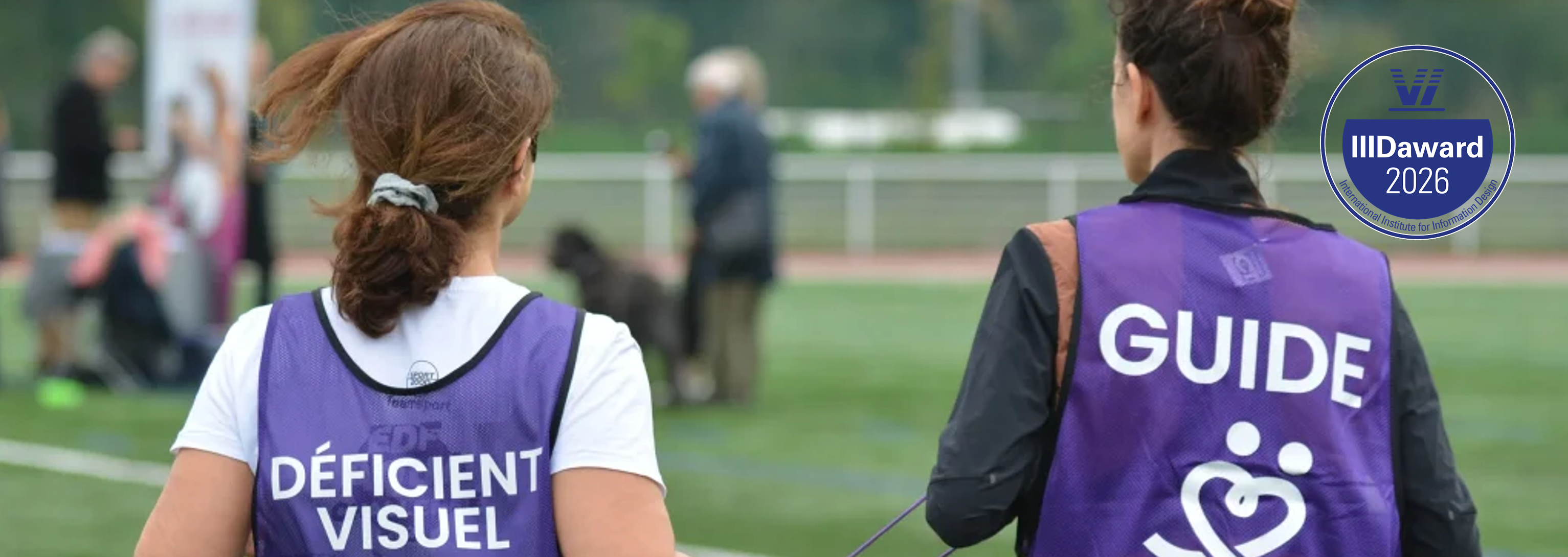
Binomes
Binomes – Putting digital technology and AI in service of parasport, without compromising on accessibility
The context
Customer experience & Design, Data & AI
Sport for all, a challenge that remains unmet
BINOMES connects visually impaired people with sighted volunteer guides so they can practice sport together. To give this mission a national reach, ekino put AI in service of human expertise – not in its place.
In France, a visually impaired athlete cannot run, cycle, or hike alone. They depend on a sighted guide. Finding that person is often harder than the training itself.
Local associations do essential work, but operate within regional boundaries and limited resources. Matchmaking relies on word of mouth and tools never designed to handle national-scale growth. Many athletes give up, unable to find a partner nearby.
BINOMES was built around this reality: connecting people with visual impairments to volunteer guides so they can practice sport together, anywhere in France.
The objective
Giving BINOMES the digital means to fulfill its national mission
The association’s platform could no longer keep pace with its growth or meet the accessibility standards its users required. BINOMES needed a unified, scalable digital infrastructure – one designed from the outset for visually impaired people navigating the web without being able to read the screen.
The objective was twofold: build a platform capable of scaling nationally, and make accessibility the foundation of every design decision, not a constraint bolted on at the end.
- 6 — months from design to go-live
- +1,200 — members
- 100% — RGAA compliance, verified by the French government
- 1 — IIID Award 2026, Social Affairs category
Two intertwined challenges
The first challenge was architectural. Manual processes had to give way to fully unified user journeys covering registration, search, matching, and training – supported by an infrastructure capable of growing with the association.
The second challenge was human. How do you model a trust-based journey between two strangers agreeing to practice sport together? The stakes went far beyond the technical: it was about understanding what makes a successful match, and translating that dynamic into a digital architecture.
Designing for disability first, not for the able
bodied
Strategy and execution moved forward together from day one. Accessibility was never a late-stage compliance matter: it guided every design and development decision.
An accessibility specialist joined the team during the design phase. Every screen was first conceived for non-sighted navigation, then adapted for sighted users, not the other way around. To validate these choices under real conditions, ekino worked with the [Fondation Valentin Haüy](https://www.fondationvalentinhauy.fr/), France’s leading organisation for the support of visually impaired people. Three blind or partially sighted users evaluated every user journey, and their feedback directly shaped interface decisions.
On the functional side, consultants and designers co-built all user journeys with the association, from registration through to first contact.
AI as an enabler of ambition
One of the most common uses of AI in digital projects today is accelerating production and development. On this project, the question was different. How do you mobilise more human expertise where it creates real value? How do you go further than a conventional team could have gone in the same time?
AI handled the low-value tasks: generating specifications, producing UI component variants, running repetitive RGAA compliance checks, producing documentation. 70% of accessibility checks were automated. UI screen production was multiplied by five. The remaining 30% of checks were handled by a human expert, who could focus their attention where their judgment was irreplaceable.
The result: a team of eight delivered an industrial-quality solution in six months. Not because AI replaced anyone. Because it freed human expertise to concentrate where no tool can substitute for it: relationship, judgment, nuance.
AI was not at the centre of this project. It made the ambition possible.
A complete platform, accessible by design
BINOMES now has a full platform, and soon an iOS and Android mobile app, to connect athletes and guides at national scale.
An affinity-based search engine lets each user find a compatible partner based on sport, location, level, availability, and type of disability. Detailed profiles, a directory of local associations, and direct contact channels round out the experience. A full back-office gives the association complete autonomy over its content, accounts, and training programmes.
The architecture is built on modular components: Astro for the institutional site, Expo and React Native for a consistent web and mobile experience, Strapi as the CMS, Supabase for the database, and Scaleway for sovereign, secure hosting. An architecture that scales with the association, free from unwanted technical dependencies.
Accessibility is native, not cosmetic. The entire interface works with assistive voice technologies: enhanced contrast, adapted touch targets, explicit labels for screen readers. The site achieves 100% RGAA compliance, a score verified on the French government’s official platform.
Concrete impact, international recognition
Athletes who had given up for lack of a partner can once again train regularly. Volunteer guides finally have a dedicated space to signal their availability and find a match.
The approach has received international recognition: BINOMES was awarded the IIID Award 2026 in the Social Affairs category, a distinction recognising the project’s total accessibility and social impact.
But the result that matters most is not this award. It is the woman who told the BINOMES team that before the platform, her sport was limited to climbing the stairs of her building. Today, she runs through forests.
The IIID Award in the Social Affairs category recognises the excellent collaboration between BINOMES, ekino, and above all the visually impaired people who were involved throughout the project. This international recognition highlights the universal nature of BINOMES’ mission: bringing together people with disabilities and their guides through the shared experience of sport. It also validates our strategy of putting digital technology and AI in service of BINOMES’ development, of the fight against disability – in France, and perhaps tomorrow on an international stage. Thank you and congratulations to all the teams.
A replicable model
Designing for disability first, testing with the users concerned, achieving full compliance from day one: this approach sets a methodological precedent for any digital project with an inclusive purpose.
This project illustrates what ekino has long believed about AI: integrated at every stage of a rigorous production chain, driven by teams who know what they are validating and why, it does not serve to do as much with less. It makes it possible to do more with the same, and to go where you could not have gone without it.
That is what AI looks like when it becomes human again: when it steps back and lets its purpose speak for itself.
Let's build together!
Tell us about yourself, your projects, your ambitions, your challenges, your customers and let’s co-create concrete solutions that will contribute to your transformation. We will contact you shortly to learn more.
Work


Got a project?
Tell us about yourself, about your projects, your ambitions and your challenges — and let's build together the concrete solutions that will drive your transformation.